 Tel.
Tel. 
Ribe VikingeCenter receives funding for historical bishop’s garments for Ansgar
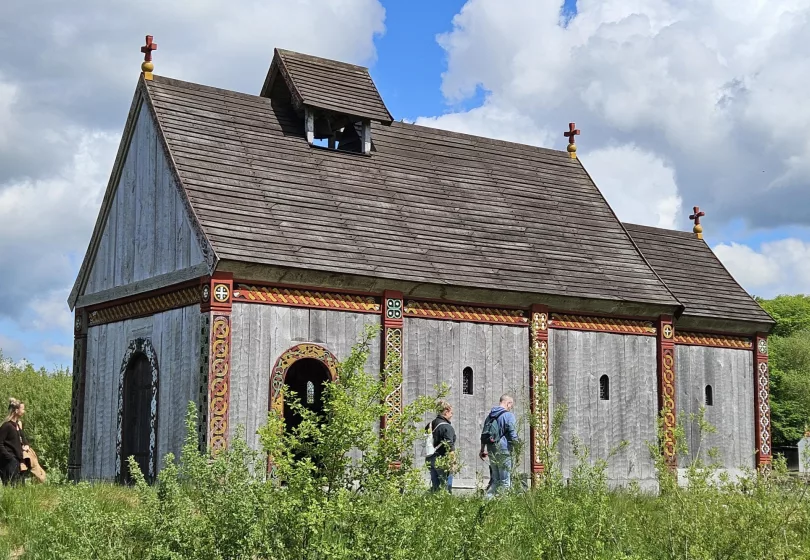
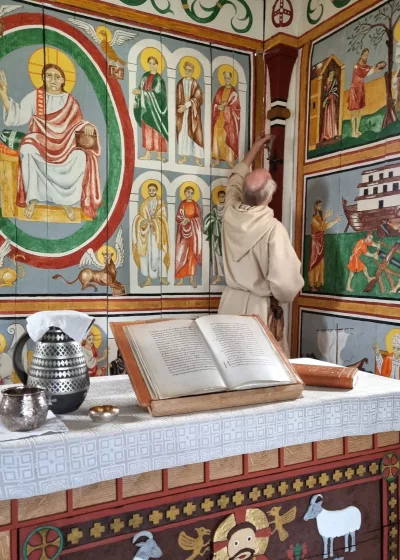
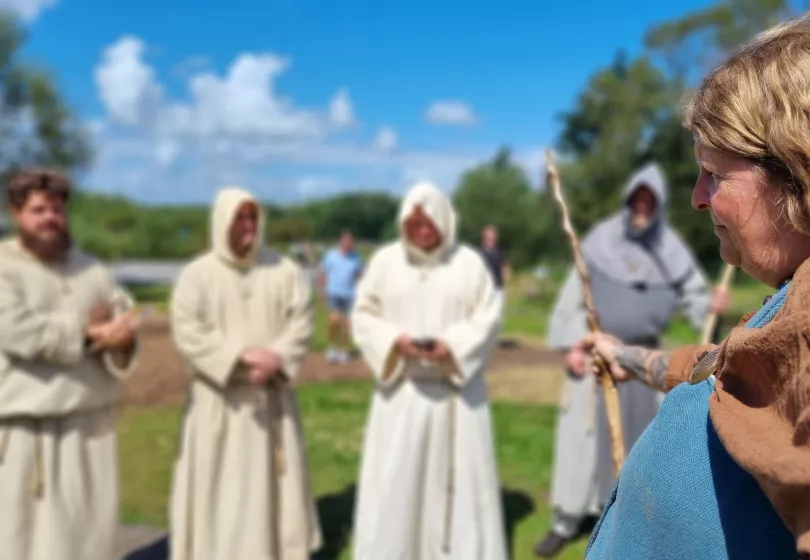
This year marks the 1,200th anniversary of the missionary Ansgar’s arrival in Denmark in AD 826, when he became a central figure in the introduction of Christianity to the country. At Ribe VikingeCenter, the story of the meeting between the old Norse faith and the new Christian faith already plays an important role in the Centre’s interpretation of the period. The Centre has reconstructed a wooden church corresponding to the one Ansgar was permitted to build in Ribe in the mid 9th century. Here, visitors can experience the very first steps of Christianity alongside the old faith, which is interpreted through features such as sacrificial sites, ceremonies and statues of the Norse gods. At the same time, the church, burial ground and historical ceremonies offer insight into the new faith that gradually took root in Denmark.
The new bishop’s garments will become part of this interpretation and will be created with a strong emphasis on historical craftsmanship and authenticity. The work is based on extensive research into European sources from the 9th century, as there are no Danish finds or contemporary depictions of Christian garments from this period.
The garments will be sewn and embroidered by Ribe VikingeCenter’s textile interpreter Anna Lund together with the Centre’s volunteer textile craftspeople, while the experienced weaver Flemming Grundtvig Lundholm will weave, among other things, the cloth for the chasuble.
Visitors will have the opportunity to follow the work at close quarters during week 29, when Ribe VikingeCenter holds its annual event week focusing on Viking textile crafts. During the week, the bishop’s garments will be completed as part of the live interpretation programme.
At Ribe VikingeCenter, there is great appreciation for the grant from the Therkel Jørgensens Foundation and enthusiasm about the opportunity to add yet another layer to the story of Denmark’s change of faith. The garments will become both an important interpretive element in ceremonies and part of the exhibition in the church. The Centre’s volunteers are also looking forward to working on the project and to helping create a historical clothing ensemble that will play a role in the interpretation of a decisive period in Danish history for years to come.
/Ribe VikingeCenter, May 2026
Facts
- The bishop’s robe consists of undergarments, a bishop’s tunic, pallium, chasuble, stockings and leg wraps. The costume will be completed with dress pins, shoes, a belt and a bishop’s staff.
- The robe is being created on the assumption that Ansgar arrived in Ribe from his episcopal seat in Hamburg Bremen, where the garments were most likely produced.
- The robe will be made from wool, linen and silk. Textile interpreter Anna Lund and Ribe VikingeCenter’s volunteer textile craftspeople are responsible for plant dyeing, measuring, cutting, hand sewing and embroidery. Flemming Grundtvig Lundholm is weaving the wool fabric for, among other things, the chasuble.
Further information
- Christin V. Clausen, manager and dramaturg, Ribe VikingeCenter, christin@ribevikingecenter.dk, tel. 24 77 45 40